Dr. Pravin D. Badhe, Swalife Biotech Pvt. Ltd. Ireland, India
Doi: – 10.5281/zenodo.21884609
Introduction
The scientific community is generating knowledge at an unprecedented rate. Thousands of research papers, clinical trial reports, patents, and scientific databases are published every day across biomedical and life sciences domains. While this wealth of information holds immense potential for innovation, researchers often struggle to keep pace with the growing volume of literature.
Artificial Intelligence (AI)-powered literature mining is emerging as a transformative solution to this challenge. By automatically analyzing, organizing, and extracting valuable insights from vast collections of scientific documents, AI enables researchers to identify relevant information, discover hidden relationships, and accelerate decision-making.
As research becomes increasingly data-intensive, AI-powered literature mining is redefining how scientific knowledge is accessed, interpreted, and utilized. [1,2]

What Is AI-Powered Literature Mining?
AI-powered literature mining refers to the application of artificial intelligence, machine learning, and natural language processing (NLP) technologies to analyze large volumes of scientific and technical literature.
Instead of manually reviewing thousands of publications, researchers can leverage AI systems to:
- Search and retrieve relevant studies
- Extract key findings and evidence
- Identify emerging research trends
- Discover relationships between genes, diseases, drugs, and biomarkers
- Summarize scientific information
- Generate actionable research insights
The technology transforms unstructured scientific text into structured knowledge that can support faster and more informed research decisions. [1,3]
Challenges of Traditional Literature Review
Traditional literature review remains a cornerstone of scientific research, but it faces several limitations:
- Information Overload
The number of published scientific articles continues to grow exponentially, making comprehensive manual review increasingly difficult.
- Time-Consuming Processes
Researchers often spend weeks or months collecting, reading, and organizing relevant publications before initiating experiments or development projects.
Hidden Knowledge Gaps
Important relationships between studies may remain unnoticed when reviewing literature manually.
- Difficulty in Tracking Emerging Trends
New discoveries can be missed due to the overwhelming volume of publications across multiple disciplines.
These challenges create opportunities for AI-driven solutions that enhance research efficiency and knowledge discovery. [1,4]
How AI-Powered Literature Mining Works
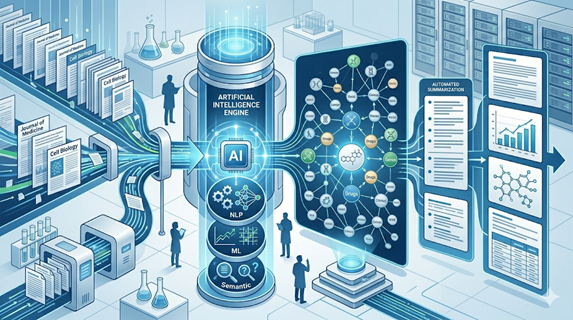
Modern literature mining platforms combine multiple AI technologies to process scientific information.
- Natural Language Processing (NLP)
NLP enables AI systems to understand scientific language, recognize key concepts, and interpret contextual relationships within research publications [4].
- Machine Learning Algorithms
Machine learning models identify patterns across thousands of documents and continuously improve information retrieval accuracy.
- Knowledge Graph Construction
AI creates interconnected networks linking diseases, genes, proteins, drugs, pathways, and clinical outcomes, helping researchers visualize complex relationships.
- Semantic Search
Unlike traditional keyword searches, semantic search understands the meaning behind queries and retrieves more relevant scientific evidence [5].
- Automated Summarization
AI can generate concise summaries of lengthy publications, allowing researchers to rapidly assess study relevance.
Applications in Life Sciences and Healthcare
AI-powered literature mining is transforming multiple areas of biomedical research.
- Drug Discovery and Development
Researchers can identify novel therapeutic targets, understand disease mechanisms, and discover potential drug candidates more efficiently.
- Biomarker Identification
AI helps uncover biomarkers associated with disease progression, treatment response, and patient stratification.
- Clinical Research
Literature mining supports evidence synthesis, protocol development, and identification of relevant clinical trial findings.
- Precision Medicine
AI enables researchers to connect genetic information with disease outcomes and treatment responses, supporting personalized healthcare approaches.
- Competitive Intelligence
Organizations can monitor scientific advancements, patent activity, and emerging technologies to inform strategic decisions.
Benefits of AI-Powered Literature Mining
- Faster Knowledge Discovery
AI significantly reduces the time required to identify relevant scientific evidence.
- Improved Research Productivity
Researchers spend less time on manual searching and more time on innovation and experimentation.
- Better Decision-Making
Comprehensive evidence analysis supports more confident scientific and business decisions.
- Identification of Hidden Connections
AI can uncover relationships that may not be immediately apparent through conventional review methods.
- Enhanced Innovation
Rapid access to scientific insights accelerates the development of new therapies, diagnostics, and healthcare solutions.
Future Scope of AI-Powered Literature Mining
The future of literature mining extends beyond simple information retrieval.
Emerging technologies are expected to enable:
- Real-time scientific trend monitoring
- Predictive identification of promising research areas
- AI-generated research hypotheses
- Automated evidence synthesis for clinical decision support
- Integration of literature data with genomic, proteomic, and real-world evidence datasets
- Intelligent research assistants capable of continuous knowledge discovery
As AI systems become more sophisticated, they will serve as strategic partners for researchers, helping transform information into innovation at unprecedented speed [6].
How Swalife Biotech Supports AI-Driven Research Intelligence
At Swalife Biotech, AI-powered literature mining represents a critical component of modern research intelligence. By leveraging advanced analytics, natural language processing, and knowledge discovery technologies, researchers can efficiently navigate vast scientific datasets and uncover actionable insights.
From identifying emerging therapeutic opportunities to monitoring scientific trends and supporting evidence-based decision-making, AI-driven literature mining empowers organizations to accelerate research, reduce information overload, and enhance innovation outcomes.
Conclusion
The rapid growth of scientific literature presents both opportunities and challenges for researchers. AI-powered literature mining addresses these challenges by transforming massive volumes of unstructured information into meaningful knowledge.
As the life sciences industry continues to embrace digital transformation, AI-powered literature mining will become an essential tool for accelerating discovery, improving research efficiency, and driving the next generation of healthcare and pharmaceutical innovation.
References: –
- Zhao S, Su C, Lu Z, Wang F. Recent advances in biomedical literature mining. Brief Bioinform. 2021 May 20;22(3):bbaa057. doi: 10.1093/bib/bbaa057. PMID: 32422651; PMCID: PMC8138828. https://pmc.ncbi.nlm.nih.gov/articles/PMC8138828/
- Rebholz-Schuhmann, D., Oellrich, A. & Hoehndorf, R. Text-mining solutions for biomedical research: enabling integrative biology. Nat Rev Genet 13, 829–839 (2012). https://doi.org/10.1038/nrg3337
- de Bruijn B, Martin J. Getting to the (c)ore of knowledge: mining biomedical literature. Int J Med Inform. 2002 Dec 4;67(1-3):7-18. doi: 10.1016/s1386-5056(02)00050-3. PMID: 12460628. https://pubmed.ncbi.nlm.nih.gov/12460628/
- Santos ÁOD, da Silva ES, Couto LM, Reis GVL, Belo VS. The use of artificial intelligence for automating or semi-automating biomedical literature analyses: A scoping review. J Biomed Inform. 2023 Jun;142:104389. doi: 10.1016/j.jbi.2023.104389. Epub 2023 May 13. PMID: 37187321. https://pubmed.ncbi.nlm.nih.gov/37187321/
- Chih-Hsuan Wei, Alexis Allot, Robert Leaman, Zhiyong Lu, PubTator central: automated concept annotation for biomedical full text articles, Nucleic Acids Research, Volume 47, Issue W1, 02 July 2019, Pages W587–W593, https://doi.org/10.1093/nar/gkz389
- Wang Z, Cao L, Jin Q, Chan J, Wan N, Afzali B, Cho HJ, Choi CI, Emamverdi M, Gill MK, Kim SH, Li Y, Liu Y, Ong H, Rousseau J, Sheikh I, Wei JJ, Xu Z, Zallek CM, Kim K, Peng Y, Lu Z, Sun J. A foundation model for human-AI collaboration in medical literature mining. ArXiv [Preprint]. 2025 Jan 27:arXiv:2501.16255v1. Update in: Nat Commun. 2025 Sep 24;16(1):8361. doi: 10.1038/s41467-025-62058-5. PMID: 40735107; PMCID: PMC12306811. https://pubmed.ncbi.nlm.nih.gov/40735107/