Dr. Pravin D. Badhe, Swalife Biotech Pvt. Ltd. Ireland, India
Doi: – 10.5281/zenodo.21883898
Introduction:
Why Clinical Trial Design Needs Innovation
Clinical trials are the foundation of drug development, ensuring that new therapies are safe and effective before reaching patients. However, traditional clinical trials are often expensive, time-consuming, and prone to delays caused by complex protocols, slow patient recruitment, and high dropout rates. Studies show that bringing a new medicine to market can take more than a decade, with clinical trials accounting for a significant portion of development costs [1,2].
Artificial Intelligence (AI) is transforming clinical research by improving trial design, optimizing patient recruitment, enhancing data analysis, and supporting evidence-based decision-making. AI-driven clinical trial design enables researchers to conduct smarter, faster, and more efficient studies while improving patient outcomes [2,3].
Understanding Clinical Trial Design
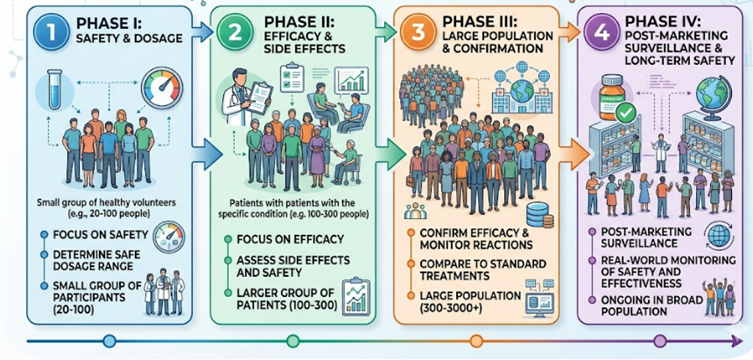
Clinical trial design is the process of planning how a clinical study will evaluate the safety and effectiveness of a medical intervention. Clinical trials typically progress through Phase I, II, III, and IV, each serving a specific purpose in assessing safety, efficacy, dosage, and long-term outcomes [3].
Traditional trial designs often rely on manual planning and historical data, making them vulnerable to inefficiencies. AI-assisted clinical trial design uses predictive analytics and large healthcare datasets to improve protocol development, patient selection, and operational efficiency.
How Artificial Intelligence is Transforming Clinical Trial Design
Artificial Intelligence is reshaping every stage of clinical trial design by enabling more informed and data-driven decisions.
AI can analyze electronic health records, genomic data, scientific literature, and real-world evidence to identify eligible participants, optimize eligibility criteria, and improve protocol design. Predictive models help estimate recruitment timelines, identify high-performing clinical sites, and forecast potential risks before trials begin.
AI also supports continuous monitoring throughout the study, allowing researchers to detect safety signals earlier and improve overall trial quality [2,4].
Key AI Technologies Used in Clinical Trials
Several AI technologies are driving innovation in clinical research:
- Machine Learning for patient risk prediction and recruitment.
- Deep Learning for analyzing complex biomedical datasets.
- Natural Language Processing (NLP) for extracting insights from clinical notes and scientific literature.
- Predictive Analytics for forecasting trial outcomes and identifying recruitment challenges.
- Generative AI for protocol development and document generation.
- Evidence Intelligence for synthesizing research evidence and supporting clinical decision-making.
Together, these technologies improve efficiency, reduce manual workload, and support evidence-based clinical research [2,5].
Applications of AI Across the Clinical Trial Lifecycle
AI is transforming multiple stages of clinical trials.
Patient Recruitment
AI rapidly identifies eligible participants by analyzing electronic health records and real-world data, reducing recruitment delays.
Protocol Optimization
Machine learning improves study design by identifying unnecessary complexity and optimizing eligibility criteria.
Biomarker Discovery
AI analyzes genomic and molecular data to identify biomarkers that support precision medicine.
Trial Monitoring
Real-time monitoring enables early detection of safety issues, protocol deviations, and patient dropout risks.
Regulatory Documentation
Natural Language Processing assists researchers in preparing regulatory documents and summarizing clinical evidence more efficiently.
These applications improve both trial efficiency and data quality while accelerating drug development.
Benefits of AI in Clinical Trial Design
AI provides several important advantages for clinical research:
- Faster patient recruitment.
- Reduced clinical trial costs.
- Improved protocol quality.
- Better patient diversity.
- Enhanced data accuracy.
- Improved regulatory compliance.
- Higher clinical trial success rates.
- Faster drug development and approval.
By reducing operational inefficiencies, AI enables researchers to deliver innovative therapies to patients more quickly [1,4].
Challenges and Ethical Considerations
Despite its potential, AI implementation in clinical trials presents several challenges.
High-quality datasets are essential for reliable predictions, while incomplete or biased data may affect model performance. Protecting patient privacy and ensuring regulatory compliance remain critical priorities. Additionally, AI models should be transparent and explainable so researchers and regulators can understand how decisions are generated.
Human oversight remains essential to validate AI recommendations and maintain ethical standards throughout clinical research [2,5].
The Future of AI in Clinical Trials
The future of clinical research will increasingly rely on AI-powered technologies.
Emerging innovations include decentralized clinical trials, digital twins, wearable health devices, remote patient monitoring, and integration of Real-World Evidence (RWE). These technologies will enable continuous data collection, personalized trial designs, and more accurate prediction of patient outcomes.
AI will also support adaptive clinical trials that modify study parameters in real time based on incoming evidence, improving both efficiency and patient safety.
How Swalife Biotech is Advancing AI-Driven Clinical Research
Swalife Biotech is committed to advancing clinical research through Artificial Intelligence, Clinical Intelligence, Evidence Intelligence, Real-World Evidence, and Predictive & Decision Medicine Intelligence (PDMI).
By integrating AI-powered literature analytics, scientific intelligence, predictive analytics, and translational research, Swalife Biotech aims to accelerate evidence generation, improve clinical decision-making, optimize drug development, and support precision medicine.
The organization envisions an intelligent healthcare ecosystem where AI transforms clinical research into faster, smarter, and more patient-centered innovation.
Conclusion: Building the Future of Intelligent Clinical Research
Artificial Intelligence is redefining clinical trial design by making studies more efficient, accurate, and patient-focused. From protocol optimization and patient recruitment to predictive analytics and regulatory support, AI is accelerating every stage of clinical research.
Although challenges related to data quality, ethics, and regulation remain, continued advances in AI will transform how clinical trials are designed and conducted. As healthcare becomes increasingly data-driven, AI-powered clinical research will play a central role in delivering safer therapies, improving patient outcomes, and advancing precision medicine. Organizations like Swalife Biotech are helping shape this future through AI-driven Evidence Intelligence, Clinical Intelligence, and innovative healthcare solutions.
References
1.Harrer S, Shah P, Antony B, Hu J. Artificial Intelligence for Clinical Trial Design. Academic Press; 2019. https://www.sciencedirect.com/
2.World Health Organization. Harnessing Artificial Intelligence for Health. Geneva: WHO; 2025. https://www.who.int/
3.National Academies of Sciences, Engineering, and Medicine. The Role of Digital Health Technologies in Drug Development. Washington, DC: National Academies Press; 2020. https://www.nationalacademies.org/
4.U.S. Food and Drug Administration. Step 3: Clinical Research. Silver Spring, MD: FDA. Available from: https://www.fda.gov/patients/drug-development-process/step-3-clinical-research
5.European Medicines Agency. Artificial Intelligence in Medicines Regulation. Amsterdam: EMA; 2023. https://www.ema.europa.eu/