Dr. Pravin D. Badhe, Swalife Biotech Pvt. Ltd. Ireland, India
Doi: – 10.5281/zenodo.21912435
Introduction
Clinical research is entering a new digital era. Traditional clinical trials have historically relied on centralized research sites where participants travel for screening, treatment, and follow-up visits. While effective, this model often faces challenges such as slow patient recruitment, geographical limitations, high operational costs, and participant dropout rates. Today, advances in digital health technologies, Artificial Intelligence (AI), telemedicine, and remote monitoring are transforming how clinical research is conducted.
Decentralized Clinical Research (DCR) is emerging as a patient-centric approach that enables researchers to conduct clinical studies remotely while maintaining data quality and regulatory compliance. By reducing barriers to participation and increasing access to research opportunities, decentralized research is reshaping the future of clinical development and evidence-based healthcare [1,2].
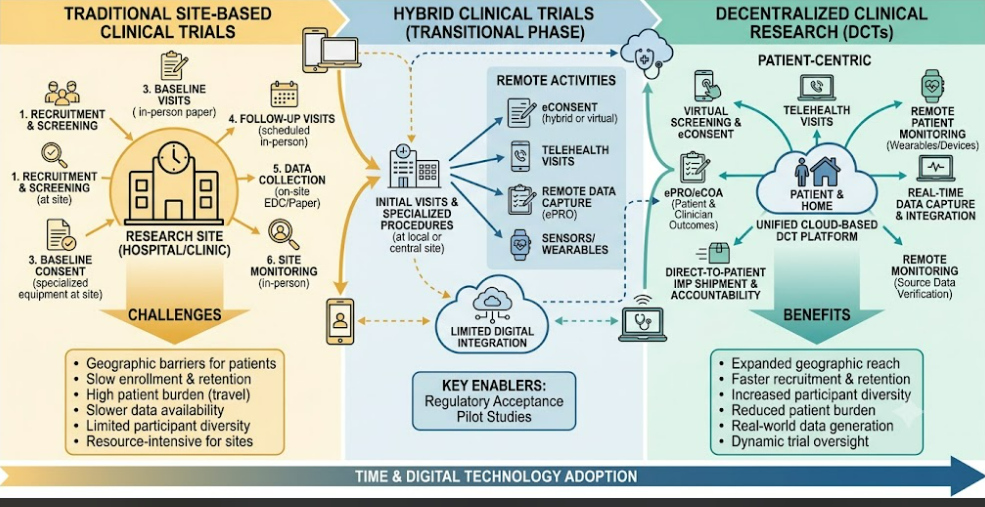
What Is Decentralized Clinical Research?
Decentralized Clinical Research refers to a research model in which some or all clinical trial activities are conducted remotely rather than exclusively at physical study sites. Participants can engage in research from their homes through digital platforms, wearable devices, mobile applications, and telemedicine services [1,2].
Key technologies supporting decentralized research include:
- Telemedicine and virtual consultations
- Wearable health monitoring devices
- Mobile health applications
- Electronic Consent (eConsent)
- Electronic Patient-Reported Outcomes (ePRO)
- Remote patient monitoring systems
- Cloud-based clinical data platforms
These technologies improve participant convenience while enabling continuous and real-time data collection.
Why Decentralized Clinical Research Matters
Improved Patient Recruitment
Traditional trials often struggle to recruit participants from diverse populations. Decentralized research removes geographical barriers, enabling broader patient participation and improving study diversity [3].
Enhanced Patient Retention
Reducing travel requirements and in-person visits increases participant convenience, leading to better engagement and lower dropout rates.
Faster Clinical Trial Execution
Digital platforms streamline recruitment, monitoring, and communication processes, helping accelerate study timelines.
Greater Access to Research
Patients living in rural or underserved regions can participate in clinical studies without traveling to major research centres.
Real-World Data Collection
Wearables and connected health devices collect continuous patient data in real-life settings, generating valuable real-world evidence for clinical decision-making.
Key Technologies Driving Decentralized Clinical Research
Telemedicine
Virtual consultations allow investigators and participants to interact remotely while maintaining clinical oversight.
Wearable Devices
Smartwatches, biosensors, and connected medical devices continuously collect health information such as:
- Heart rate
- Blood pressure
- Physical activity
- Sleep patterns
- Blood glucose levels
Artificial Intelligence
AI analyzes large clinical datasets, identifies patterns, predicts risks, and supports decision-making throughout the trial lifecycle.
Electronic Consent (eConsent)
Digital consent platforms simplify participant enrollment while improving transparency and compliance.
Electronic Patient-Reported Outcomes (ePRO)
Patients can directly report symptoms, treatment experiences, and quality-of-life information through digital platforms.
Benefits of Decentralized Clinical Research
The decentralized approach offers numerous advantages:
- Faster participant recruitment.
- Improved patient diversity.
- Reduced operational costs.
- Enhanced patient convenience.
- Continuous data collection.
- Better patient engagement.
- Improved real-world evidence generation.
- Increased clinical trial efficiency.
These benefits support more patient-centered and efficient clinical research programs [4].
Challenges and Considerations
Despite its advantages, decentralized clinical research presents several challenges.
Data Privacy and Security
Large volumes of digital health data require strong cybersecurity measures and regulatory compliance.
Technology Accessibility
Not all participants have access to smartphones, internet connectivity, or wearable devices.
Regulatory Compliance
Researchers must comply with evolving regulations governing decentralized and hybrid clinical trials.
Data Quality and Standardization
Ensuring consistency across multiple digital platforms remains a critical challenge.
Participant Training
Patients and investigators require adequate training to effectively use digital research technologies.
The Role of Artificial Intelligence in Decentralized Research
Artificial Intelligence is becoming a cornerstone of decentralized clinical research. AI supports:
- Patient recruitment and matching.
- Remote patient monitoring.
- Clinical data analysis.
- Risk prediction.
- Adverse event detection.
- Predictive analytics.
- Decision support systems.
These capabilities improve study efficiency while enhancing participant safety and research quality [5].
Future of Decentralized Clinical Research
The future of clinical research will be increasingly digital, intelligent, and patient-centric. Several emerging trends are expected to accelerate adoption:
AI-Powered Clinical Trials
Advanced AI systems will optimize recruitment, monitoring, and data analysis.
Digital Twins
Virtual patient models may help predict treatment outcomes and improve trial design.
Continuous Remote Monitoring
Connected devices will enable real-time health tracking throughout the study period.
Real-World Evidence Integration
Future trials will increasingly combine clinical and real-world data to support evidence-based healthcare.
Precision Medicine
Decentralized research will facilitate personalized treatment strategies based on patient-specific biological and clinical characteristics.
How Swalife Biotech Contributes to This Vision
At Swalife Biotech, decentralized clinical research represents an opportunity to accelerate healthcare innovation through Artificial Intelligence, Evidence Intelligence, Real-World Evidence (RWE), and Predictive & Decision Medicine Intelligence (PDMI). By integrating scientific intelligence with digital health technologies, organizations can improve clinical trial efficiency, generate actionable insights, and support evidence-based decision-making.
As healthcare continues to embrace digital transformation, decentralized clinical research will play a central role in advancing patient-centered innovation and improving healthcare outcomes.
Conclusion
Decentralized Clinical Research is transforming the way clinical studies are designed and conducted. By leveraging telemedicine, wearable devices, AI, and remote monitoring technologies, researchers can improve participant access, accelerate recruitment, reduce costs, and generate richer real-world evidence.
Although challenges related to data privacy, regulatory compliance, and technology access remain, continued advances in digital health and AI are expected to make decentralized clinical research more efficient, accessible, and impactful. As the healthcare industry moves toward a more connected and patient-centric future, decentralized research will become a cornerstone of next-generation clinical innovation.
References
[1] U.S. Food and Drug Administration (FDA). Decentralized Clinical Trials for Drugs, Biological Products, and Devices: Guidance for Industry, Investigators, and Other Stakeholders. 2024. https://www.fda.gov/regulatory-information/search-fda-guidance-documents/conducting-clinical-trials-decentralized-elements
[2] European Medicines Agency (EMA). Decentralised Elements in Clinical Trials. 2023. https://www.ema.europa.eu/en/human-regulatory-overview/research-development/clinical-trials-human-medicines
[3] Apostolaros M, Babaian D, Corneli A, et al. Legal, Regulatory, and Practical Issues to Consider When Adopting Decentralized Clinical Trials. Therapeutic Innovation & Regulatory Science. 2020;54(4):779–787. https://doi.org/10.1007/s43441-020-00103-5
[4] Clinical Trials Transformation Initiative (CTTI). Decentralized Clinical Trials Recommendations. 2023. https://ctti-clinicaltrials.org/project/decentralized-clinical-trials/
[5] Izmailova ES, Ellis R, Benko C. Remote Monitoring in Clinical Trials During the COVID-19 Pandemic. Nature Reviews Drug Discovery. 2020;19(6):378–379. doi:10.1038/d41573-020-00094-0 https://doi.org/10.1038/d41573-020-00094-0