Introduction
Drug discovery is changing drastically. Traditionally, pharmaceutical research focused on “one drug – one target – one disease”. This technique has created many beneficial drugs, but it has difficulties in complicated diseases like cancer, diabetes, neurodegenerative disorders, inflammatory diseases, and metabolic disorders.
Multiple routes, molecular targets, and dynamic cellular responses are involved in many chronic diseases. Therefore, researchers are studying multi-target treatment techniques.
Meanwhile, medicinal plants and herbal preparations include hundreds of bioactive chemicals that may synergise. These interactions are hard to understand using reductionist methods.
Network pharmacology is a great scientific method here. Network pharmacology studies how numerous substances interact with multiple targets and pathways in biological systems using biology, chemistry, pharmacology, bioinformatics, systems biology, and AI.
Instead of asking:
Which chemical targets one protein?
Network pharmacology asks:
“How do multiple bioactive compounds affect disease-related biological networks?”
Modern drug discovery is changing, opening new doors in precision medicine, herbal medication development, and AI-driven therapeutic innovation.
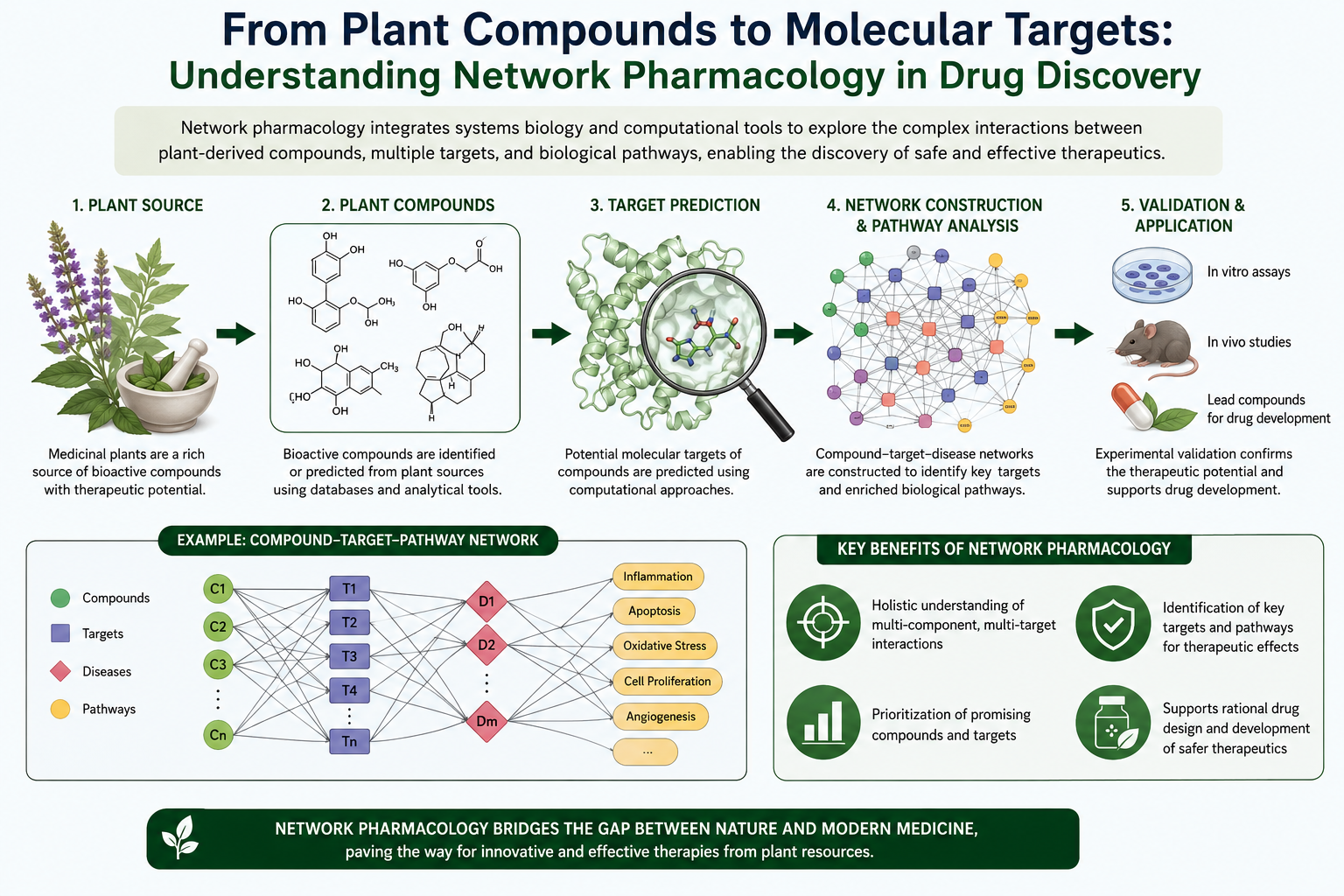
What Is Network Pharmacology?
Network pharmacology examines system-level connections between:
- Bioactive substances
- Molecular targets
- Cellular pathways
- Biological processes
- Disease networks
It helps researchers understand how natural chemicals or medication combinations affect numerous targets.
The notion fits traditional herbal therapy because many plant-derived medicines use multi-component and multi-target mechanisms.
Pharmacology network:
- Molecular biology
- Computational biology
- Bioinformatics
- Pharmacology
The use of artificial intelligence
- Systems medicine
- Omics technologies aim to develop a comprehensive understanding of illness processes and treatments.
Why Traditional Drug Discovery Faces Challenges
Traditional drug development has helped medicine, yet it has severe drawbacks:
1. Complex Diseases are multifactorial
Cancer, Alzheimer’s, cardiovascular, autoimmune, and metabolic syndromes involve multiple pathways and targets. Therapeutic effects may not be sufficient by targeting one protein.
2. Resistance to Drugs
Since biological systems can adapt through other pathways, single-target medicines may create resistance.
3. Side Effects
Drugs often interact with non-target proteins, creating side effects.
4. High Cost, Failure Rates
Many drug candidates fail clinical trials, making drug development costly and time-consuming.
5. Limited Herbal Medicine Knowledge
Traditional herbal preparations contain many chemicals that work together, but traditional approaches cannot explain their synergistic effects.
Network pharmacology studies biological systems as networks to solve many of these problems.
The Core Principle of Network Pharmacology
The core principle of network pharmacology is:
“Multiple compounds interact with multiple targets across multiple pathways to influence disease outcomes.”
This systems-level perspective allows researchers to:
- Understand therapeutic synergy
- Identify key molecular targets
- Predict biological mechanisms
- Analyze pathway interactions
- Discover biomarkers
- Evaluate safety profiles
- Support personalized medicine
The Journey: From Plant Compounds to Molecular Targets
The network pharmacology workflow typically follows several scientific stages.
Step 1: Selection of Medicinal Plants or Natural Compounds
Researchers begin with medicinal plants, herbal formulations, or natural products that demonstrate therapeutic potential.
Examples include:
- Curcumin from turmeric
- Naringin from citrus fruits
- Quercetin from onions and apples
- EGCG from green tea
- Withanolides from Ashwagandha
- Thymoquinone from Nigella sativa
At this stage, researchers may collect:
- Ethnopharmacological evidence
- Traditional medicinal knowledge
- Experimental literature
- Clinical observations
Step 2: Identification of Bioactive Compounds
Plants contain many phytochemicals including:
- Flavonoids
- Alkaloids
- Terpenes
- Phenolic acids
- Sterols
- Glycosides
Researchers identify potential active compounds using scientific databases and analytical techniques.
Common databases include:
- PubChem
- ChEMBL
- TCMSP
- DrugBank
- ChemSpider
Important properties evaluated include:
- Drug-likeness
- Oral bioavailability
- ADMET properties
- Molecular weight
- Lipophilicity
This step helps prioritize compounds with therapeutic potential.
Step 3: Target Prediction
Once compounds are identified, researchers predict which proteins or genes those compounds may interact with.
This is one of the most important steps in network pharmacology.
Target prediction may involve:
- Molecular docking
- Machine learning algorithms
- AI prediction models
- Chemoinformatics
- Similarity-based screening
Common target databases include:
- SwissTargetPrediction
- STITCH
- BindingDB
- SEA Search Server
Potential targets may include:
- Enzymes
- Receptors
- Kinases
- Transcription factors
- Ion channels
- Cytokines
Step 4: Disease Target Identification
Researchers identify genes and proteins associated with a disease.
Examples:
- Breast cancer genes
- Inflammatory pathway genes
- Oxidative stress markers
- Neurodegenerative biomarkers
Common databases include:
- GeneCards
- OMIM
- DisGeNET
- CTD Database
The goal is to determine:
Which disease targets overlap with compound targets?
These overlapping targets become potential therapeutic targets.
Step 5: Network Construction
The identified relationships are then converted into biological interaction networks.
Common networks include:
- Compound-target networks
- Protein-protein interaction (PPI) networks
- Target-pathway networks
- Disease-target networks
Researchers often use software such as:
- Cytoscape
- STRING
- Gephi
- NetworkAnalyst
These visual networks help identify:
- Hub genes
- Key pathways
- Central therapeutic targets
- Highly connected proteins
Hub proteins often play major roles in disease progression.
Step 6: Pathway Enrichment Analysis
After identifying targets, researchers analyze biological pathways influenced by those targets.
Pathway analysis helps answer:
- Which pathways are regulated?
- Which biological processes are affected?
- What mechanisms may explain therapeutic effects?
Common pathway databases include:
- KEGG
- Reactome
- WikiPathways
- GO Enrichment Analysis
Important pathways may involve:
- Apoptosis
- PI3K-Akt signaling
- NF-κB signaling
- MAPK pathway
- Oxidative stress pathways
- Immune regulation
- Cell cycle regulation
This step provides mechanistic understanding.
Step 7: Molecular Docking and Validation
Researchers may further validate interactions using:
- Molecular docking
- Molecular dynamics simulations
- In vitro studies
- In vivo studies
- Transcriptomics
- Proteomics
Docking studies help evaluate:
- Binding affinity
- Molecular interactions
- Stability of ligand-target complexes
Experimental validation strengthens computational findings.
Role of Artificial Intelligence in Network Pharmacology
Artificial intelligence is increasingly transforming network pharmacology.
AI can help:
- Mine large scientific literature datasets
- Predict compound-target interactions
- Analyze omics data
- Identify hidden patterns
- Generate therapeutic hypotheses
- Predict toxicity
- Support personalized medicine
Machine learning and deep learning models can process enormous biological datasets faster than traditional approaches.
AI-integrated network pharmacology is becoming highly important in:
- Precision medicine
- Predictive therapeutics
- Clinical intelligence
- Drug repurposing
- Biomarker discovery
Applications of Network Pharmacology
Network pharmacology has applications across many areas of biomedical research.
1. Cancer Research
Researchers use network pharmacology to identify:
- Anti-cancer targets
- Apoptosis-related pathways
- Chemopreventive mechanisms
- Tumor microenvironment interactions
Plant-derived compounds are increasingly explored for:
- DNA damage modulation
- Oxidative stress regulation
- Inflammatory pathway inhibition
- Cell cycle regulation
2. Herbal Drug Discovery
Network pharmacology is especially valuable in understanding:
- Multi-herb formulations
- Synergistic interactions
- Traditional medicinal systems
- Polyherbal mechanisms
This supports scientific validation of herbal medicine.
3. Personalized Medicine
Different patients may respond differently to therapies.
Network pharmacology combined with AI can help:
- Identify patient-specific pathways
- Predict therapeutic responses
- Design precision formulations
- Improve treatment strategies
4. Drug Repurposing
Existing drugs may affect pathways involved in other diseases.
Network pharmacology can identify new therapeutic uses for known compounds.
5. Pharmacovigilance and Safety Prediction
Multi-target analysis can help predict:
- Adverse drug reactions
- Toxicity mechanisms
- Off-target interactions
- Drug-drug interactions
This supports safer therapeutic development.
Advantages of Network Pharmacology
Holistic Understanding
Provides systems-level understanding rather than isolated target analysis.
Multi-Target Discovery
Helps identify therapeutic synergy across pathways.
Faster Hypothesis Generation
Accelerates discovery using computational tools.
Cost Reduction
Supports early-stage prioritization before expensive laboratory studies.
Better Herbal Research
Scientific validation of traditional medicinal systems.
Precision Medicine Potential
Supports individualized therapeutic strategies.
Challenges in Network Pharmacology
Despite its advantages, network pharmacology also faces challenges.
Data Quality
Public databases may contain incomplete or inconsistent information.
Biological Complexity
Human biology involves highly dynamic systems.
Experimental Validation
Computational predictions still require laboratory confirmation.
Standardization Issues
Herbal formulations may vary in composition.
Integration Challenges
Combining multi-omics, AI, and biological data requires sophisticated approaches.
Nevertheless, advances in computational biology and AI continue to improve the field.
Future of Network Pharmacology
The future of drug discovery is moving toward integrated systems medicine.
Emerging trends include:
- AI-powered target prediction
- Digital twin biology
- Multi-omics integration
- Real-world evidence analysis
- Predictive clinical intelligence
- Precision herbal formulations
- Virtual screening platforms
- Explainable AI in biomedical research
The integration of:
- Artificial intelligence
- Bioinformatics
- Clinical data
- Molecular biology
- Computational pharmacology
will likely redefine how therapies are discovered and developed.
Network pharmacology may become one of the central pillars of future precision healthcare.
Conclusion
Network pharmacology represents a paradigm shift in modern drug discovery.
Instead of focusing on isolated targets, it explores the interconnected biological networks underlying disease and therapy.
By linking:
- Plant compounds
- Molecular targets
- Cellular pathways
- Disease mechanisms
researchers can better understand how complex therapies work within biological systems.
The integration of artificial intelligence, systems biology, and computational pharmacology is accelerating this transformation.
As chronic diseases become increasingly complex, multi-target therapeutic strategies may offer more effective and personalized healthcare solutions.
From medicinal plants to molecular networks, network pharmacology is helping bridge traditional medicine and modern biomedical science.
It is not simply changing drug discovery.
It is changing how we understand biology itself.