Introduction: From Nature to Market-Ready Medicines
Medicinal plants have contributed significantly to modern medicine. From paclitaxel to artemisinin, natural products have provided valuable therapeutic compounds. (1)
However, an important question remains: Why do so many promising plant extracts demonstrate biological activity in laboratories but fail to become commercially successful products?
The answer lies in challenges such as phytochemical variability, poor bioavailability, manufacturing limitations, intellectual property protection, and regulatory requirements.
Bridging this gap requires more than scientific discovery. It requires systematic product development and clinical validation.
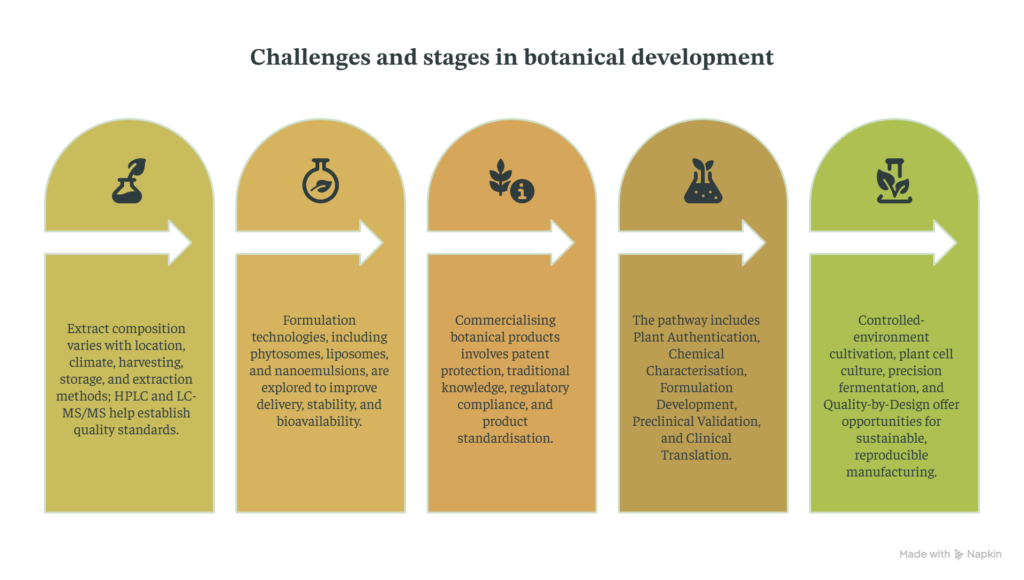
1. Phytochemical Variability and Standardisation
Botanical extracts contain complex mixtures of compounds, including flavonoids, alkaloids, polyphenols, and terpenoids.
Their composition can vary depending on geographical location, climate, harvesting, storage, and extraction methods.
This creates challenges in maintaining consistent quality and biological activity between batches. (3, 4)
Techniques such as HPLC and LC-MS/MS help researchers identify chemical markers and establish reproducible quality standards.
2. Bioavailability and Formulation Challenges
Many natural compounds demonstrate promising laboratory activity but have limitations involving solubility, absorption, and metabolism. (2, 5)
Advanced formulation technologies, including phytosomes, liposomes, and nanoemulsions, are being explored to improve delivery, stability, and bioavailability.
However, their effectiveness must be supported by appropriate experimental and clinical evidence. (5)
3. Intellectual Property and Regulatory Barriers
Commercialising botanical products involves challenges related to patent protection, traditional knowledge, regulatory compliance, and product standardisation.
Innovators must consider:
- Patent eligibility and existing intellectual property.
- Freedom to Operate (FTO).
- Product quality and safety requirements.
- Regulatory pathways and clinical evidence.
- Manufacturing consistency and traceability.
Early regulatory and intellectual property planning can help reduce development barriers. (6, 7)
4. The Lab-to-Market Development Framework
A successful botanical development pathway involves five essential stages:
- Plant Authentication: Traceable sourcing and raw material quality assessment.
- Chemical Characterisation: HPLC, LC-MS/MS, and biological fingerprinting.
- Formulation Development: Exploring advanced delivery systems.
- Preclinical Validation: ADME, pharmacokinetic, and safety evaluation.
- Clinical Translation: Regulatory planning and evidence-based clinical development.(3, 7)
5. The Future of Botanical Innovation
Emerging technologies such as controlled-environment cultivation, plant cell culture, precision fermentation, and Quality-by-Design approaches offer new opportunities for sustainable and reproducible botanical manufacturing.
Collaboration between biotechnology, pharmaceutical sciences, analytical chemistry, formulation research, and clinical research will be essential to advancing this field .(8)
Conclusion: Turning Scientific Discoveries into Real-World Solutions
The success of botanical innovation depends not only on discovering promising plant compounds but also on developing products that are reproducible, safe, stable, and scientifically validated.
Nature provides the molecules, but translational science builds the pathway from laboratory discovery to market-ready therapeutics.
References
1. Newman, D. J., & Cragg, G. M. (2020). Natural products as sources of new drugs over the nearly four decades from 01/1981 to 09/2019. Journal of Natural Products, 83(3), 770–803. https://doi.org/10.1021/acs.jnatprod.9b01285
2. Adams, D. J. (2012). The Valley of Death in anticancer drug development: A reassessment. Trends in Pharmacological Sciences, 33(4), 173–180. https://doi.org/10.1016/j.tips.2012.02.001
3. Liang, Y. Z., Xie, P., & Chan, K. (2004). Quality control of herbal medicines. Journal of Chromatography B, 812(1–2), 53–70. https://doi.org/10.1016/j.jchromb.2004.08.041 ScienceDirect
4. World Health Organization. (2018). WHO Expert Committee on Specifications for Pharmaceutical Preparations: Fifty-second report. WHO Technical Report Series No. 1010.
5. Sogut, O., Aydemir Sezer, U., & Sezer, S. (2020). Liposomal delivery systems for herbal extracts. Journal of Drug Delivery Science and Technology. https://doi.org/10.1016/j.jddst.2020.102147
ScienceDirect
6. Wong, A. Y. T., & Chan, A. W. K. (2014). Myriad and its implications for patent protection of isolated natural products in the United States. Chinese Medicine, 9, 17. https://doi.org/10.1186/1749-8546-9-17
7. US Food and Drug Administration. (2016). Botanical Drug Development: Guidance for Industry. Official FDA guidance.
8. International Council for Harmonisation. (2009). ICH Q8(R2): Pharmaceutical Development.